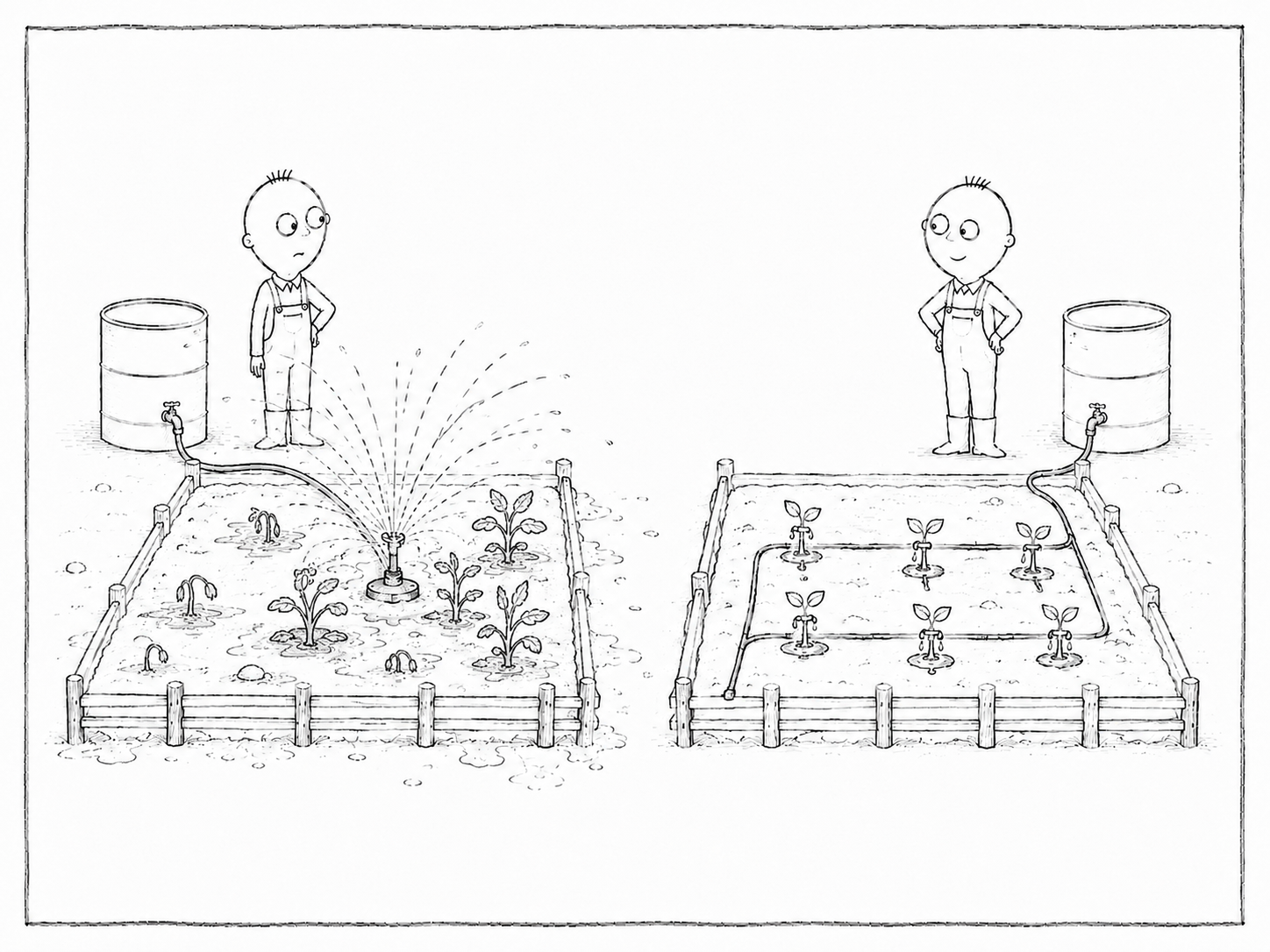
3′ RNA-Seq is a method that sequences only the region near the 3′ end of mRNA and measures gene-level expression.
It is sometimes promoted as a low-cost method for measuring large numbers of samples. However, claims that it can achieve the same sensitivity as conventional RNA-Seq with fewer reads should be treated with skepticism. If the number of usable reads per sample is reduced, the number of reads assigned to each gene will also decrease. Simply reading only the 3′ end does not automatically provide the same sensitivity as conventional RNA-Seq.
However, I believe that the more important potential of 3′ RNA-Seq lies in concentrating limited sequencing resources on the measurement of gene-level Gene Counts.
RNA-Seq Does Not Provide Sufficient Dynamic Range or Sensitivity for Low-Expression Genes
In conventional RNA-Seq, tens of millions of reads per sample are often presented as a typical sequencing depth.
However, care is needed when interpreting the term “number of reads” in paired-end RNA-Seq. For example, “20 million reads” may mean either 20 million read pairs or 20 million individual reads obtained by combining Read 1 and Read 2.
In the latter case, only 10 million read pairs are counted toward Gene Counts. Thus, even when the same expression “20 million reads” is used, the number of read pairs counted toward Gene Counts can differ by a factor of two.
Some sequencing service providers report the total number of individual reads obtained by combining Read 1 and Read 2 in paired-end sequencing simply as the total read count. This point should be clearly confirmed before placing an order.
At commonly used sequencing depths, relatively stable Gene Counts can often be obtained for genes with high to moderate expression.
In contrast, low-expression genes may receive only a few to a few dozen counts even when tens of millions of individual reads are obtained. For genes with low counts, relative variability is large, making it difficult to evaluate differential expression reliably.
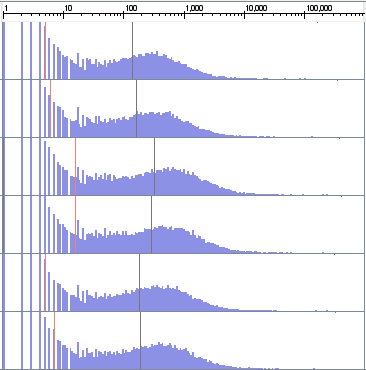
Fig. 1: Distribution of Gene Counts in conventional RNA-Seq. Each row represents one sample. Many genes fall within the low-expression range, with only a few to a few dozen counts.
As shown in Fig. 1, many genes in conventional RNA-Seq fall within a low-expression range of only a few to a few dozen counts. Because relative variability is large in this range, the sequencing depths commonly used may not be sufficient for accurately measuring low-expression genes.
Conventional RNA-Seq therefore faces a dilemma: deeper sequencing is desirable for measuring the low-expression range more accurately, but cost constraints often force a compromise. Increasing sequencing depth may move genes in the unstable low-count range into a range where they can be compared more reliably.
How Gene Counts increase across different expression ranges and how the dynamic range of RNA-Seq data changes when sequencing depth is increased are also examined using real data in The Relationship Between Read Depth and Dynamic Range in RNA-Seq .
Much of RNA-Seq is used for gene-level expression comparisons
Paired-end sequencing is widely used in conventional RNA-Seq. In paired-end sequencing, a single library fragment is read from both ends, producing two sequences: Read 1 and Read 2.
Reading both ends has clear advantages. When investigating more accurate mapping, novel transcripts, alternative splicing, fusion genes, or structural changes, the positional relationship between Read 1 and Read 2 provides important information.
However, in many practical RNA-Seq analyses, the main objective is not to discover novel transcripts or splicing events, but to calculate Gene Counts for known genes in each sample and compare gene-level expression.
If gene-level expression is the only objective, the additional information provided by paired-end sequencing may not be fully utilized.
3′ RNA-Seq makes single-end sequencing easier to justify
Conventional RNA-Seq can also be performed using single-end sequencing. However, when fragments generated randomly across entire transcripts are mapped to the genome or transcriptome, Read 2 can help determine the mapping position.
In contrast, 3′ RNA-Seq generates restricted fragments from regions near the 3′ end and close to the poly(A) tail. If the objective is gene-level expression measurement of known genes, quantification can be performed by reading the 3′ end in one direction, reducing the need for paired-end sequencing.
QuantSeq, a representative 3′ mRNA-Seq method, is also designed to measure gene-level expression by reading sequences near the 3′ end using single-end sequencing.
One advantage of 3′ RNA-Seq is therefore that single-end sequencing can be chosen rationally by focusing only on the information required for gene-level quantification.
Because single-end sequencing does not read Read 2, the sequencing cycles, reagents, and instrument time required for Read 2 are not needed.
If the money saved by omitting Read 2 can be redirected to additional sequencing using another lane or run, it may be possible to obtain more reads counted toward Gene Counts within the same budget.
Not all reads from conventional RNA-Seq are used for Gene Counts
Another important consideration is the proportion of sequenced reads that can actually be assigned to Gene Counts.
In conventional poly(A)-selected RNA-Seq, mature mRNA containing a poly(A) tail is selected before library preparation. Even so, after mapping, not all reads are assigned to exons of known genes.
The data may include reads such as the following:
- Reads mapped to intronic regions
- Reads mapped to intergenic regions
- Reads mapped to multiple genomic locations
- Reads derived from rRNA or other highly expressed RNAs
- Reads that cannot be assigned using the gene annotation being used
For example, if 70% of the sequenced read pairs are assigned to Gene Counts, only 70% of the total is used for gene-level quantification. The remaining 30% is not directly used, at least in gene-level DEG analysis of known genes.
This value of 70% is only an illustrative assumption. The actual proportion varies depending on RNA quality, library preparation method, sample type, mapping method, and the annotation used.
Restricting sequencing to the 3′ end may improve assignment efficiency to Gene Counts
In 3′ RNA-Seq, libraries are prepared selectively from regions near the poly(A) tail. The read distribution therefore differs from that of conventional RNA-Seq, which fragments and sequences the full length of transcripts.
If reads can be concentrated near the 3′ ends of mature polyadenylated RNAs, it may be possible to reduce the proportion of reads dispersed into regions that are not used for conventional gene-level counts, such as intronic and intergenic regions.
In that case, even when the same number of read pairs or single-end reads is obtained, 3′ RNA-Seq may produce a higher proportion of usable reads that can be assigned to Gene Counts than conventional RNA-Seq.
However, determining how much assignment efficiency to Gene Counts actually improves requires using the same RNA samples and comparing the proportion of reads mapped to exonic regions of known genes. At present, this remains a hypothesis that should be tested using real data.
3′ RNA-Seq also has its own limitations
Even when reads are concentrated near the 3′ end, not all reads can necessarily be assigned accurately to Gene Counts.
- Repeats in the 3′ UTR can prevent unique mapping
- Read assignment may become ambiguous between nearby genes
- Alternative polyadenylation can alter the position of the 3′ end
- Internal priming can occur at A-rich sequences
- Gene Counts may vary depending on the annotation used
- If library complexity is insufficient, deeper sequencing may mainly increase duplicate reads
Paired-end sequencing has clear advantages for mapping accuracy and for analyzing alternative splicing, novel transcripts, and fusion genes. Conventional RNA-Seq therefore cannot be replaced entirely by 3′ RNA-Seq.
The important question is whether paired-end sequencing should still be treated as the default when the objective is limited to gene-level counts of known genes.
In particular, when the genes of interest are expected to be expressed at low levels, it may be worth considering whether the budget should be spent on Read 2 or on increasing the number of reads counted toward Gene Counts.
Why 3′ RNA-Seq can be less expensive should be considered separately
3′ RNA-Seq is sometimes introduced as a method that can be performed at a low depth of only a few million reads per sample. However, if conventional RNA-Seq obtains 20 million read pairs while 3′ RNA-Seq obtains only 4 million single-end reads, the number of reads counted toward Gene Counts is reduced to one-fifth.
Low-expression genes may receive only a few to a few dozen counts even in conventional RNA-Seq. If the total number of reads is reduced further, more genes will receive zero or only a few counts, making reliable evaluation of differential expression more difficult.
The lower cost of 3′ RNA-Seq should therefore be divided into two distinct factors:
- A rational reduction in cost by omitting Read 2
- A reduction in cost by decreasing the number of single-end reads per sample
The former is an efficiency gain when the objective is gene-level counts, whereas the latter also reduces the measurement depth of low-expression genes. An experiment can remain feasible with fewer reads, but that does not mean the same range of genes can be measured with the same precision as in conventional RNA-Seq.
The True Potential of 3′ RNA-Seq
The value of 3′ RNA-Seq is not limited to reducing the number of reads and lowering the cost of an experiment.
Rather, it can:
- eliminate Read 2, which is often of limited value for gene-level quantification
- redirect the resulting cost savings toward additional sequencing or more biological replicates
- concentrate reads near the 3′ ends needed for gene-level counts
- reduce the proportion of reads that cannot be assigned to Gene Counts
It is an undeniable fact that conventional RNA-Seq often lacks sufficient precision for measuring low-expression genes. When the primary objective is gene-level expression analysis and low-expression genes are particularly important, 3′ RNA-Seq can be a practical option for improving the sensitivity of Bulk RNA-Seq within a limited budget.
Single-cell RNA-Seq is useful for capturing heterogeneity within a cell population, but the problem of unstable measurements at the individual-cell level cannot be avoided. By contrast, Bulk RNA-Seq still offers room to improve sensitivity for low-expression genes by increasing sequencing depth.
Single-cell RNA-Seq can be used to identify differences among cell types and cell states, while Bulk RNA-Seq can be used to measure gene expression more deeply and reliably. Using these two approaches as complementary pillars may be the most effective direction for future transcriptome analysis.