This page explains how Windows users can prepare their environment to import RNA-Seq FASTQ files into Subio Platform. If you are using a Mac, please see the macOS instructions.
To process RNA-Seq FASTQ files with Subio Platform, you need to prepare an environment that can run Linux programs on Windows, as well as fastp, HISAT2, StringTie, a HISAT2 index, and a GTF file.
The installation procedures for Windows and these tools may change over time. Therefore, we recommend following the general steps below and, when necessary, asking ChatGPT or another AI assistant for help with the specific procedures.
1. Enable WSL and Install Ubuntu
On Windows, Windows Subsystem for Linux (WSL) is used to run Linux programs.
Open PowerShell or Windows Terminal with administrator privileges and run the following command:
wsl --install
This installs WSL and Ubuntu.
When you start Ubuntu for the first time, you will be asked to create a Linux username and password. Once you have set the username and password, this part of the setup is complete.
When FASTQ file processing is performed from Subio Platform, you normally do not need to continue working with Linux commands in Ubuntu after this setup.
If you are unsure how to install WSL and Ubuntu, or if the screens and procedures differ depending on your Windows environment, you can ask an AI assistant a question such as, "How do I install WSL and Ubuntu on Windows?"
2. Prepare fastp, HISAT2, and StringTie
Subio Platform uses the following tools to process RNA-Seq FASTQ files:
- fastp: removes adapter sequences and low-quality reads
- HISAT2: maps sequencing reads to a reference genome
- StringTie: estimates gene expression levels from the mapping results
Although these programs will be used on a Windows computer, you need to obtain the Linux executables. Save the executable files in a folder on Windows.
Do not include spaces or non-ASCII characters in the folder path containing the fastp, HISAT2, and StringTie executable files.
For example, you can create a folder such as:
C:\RNASeqTools\
and save the tools there.
The download procedure may differ depending on the tool version. If necessary, specify the version you want to use and ask an AI assistant a question such as, "How can I download the Linux executable for this version to use with WSL on Windows?"
3. Download a HISAT2 Index and GTF File
Next, prepare a HISAT2 index and GTF file for the species you want to analyze.
HISAT2 indexes can be downloaded from the HISAT2 Download page.
Several types of indexes may be available for the same genome. For standard RNA-Seq analysis, use the genome_tran version, which includes known transcript information.
The GTF file must correspond to the same species and genome version as the HISAT2 index.
For instructions on how to obtain an appropriate GTF file from Ensembl, see:
How to Obtain a GTF File for the Appropriate Species and Genome Version from the Ensembl FTP Site
Do not include spaces or non-ASCII characters in the folder paths containing the HISAT2 index and GTF file.
4. Prepare the FASTQ Files
Save the FASTQ files to be analyzed in a folder on Windows.
Do not include spaces or non-ASCII characters in the folder path containing the FASTQ files.
5. Specify the File Locations in Subio Platform
After preparing the required files, open the RNA-Seq FASTQ file import screen in Subio Platform and click Settings... to specify the locations of the fastp, HISAT2, and StringTie executable files, as well as the HISAT2 index and GTF file.
Specify each file in the corresponding field as shown below.
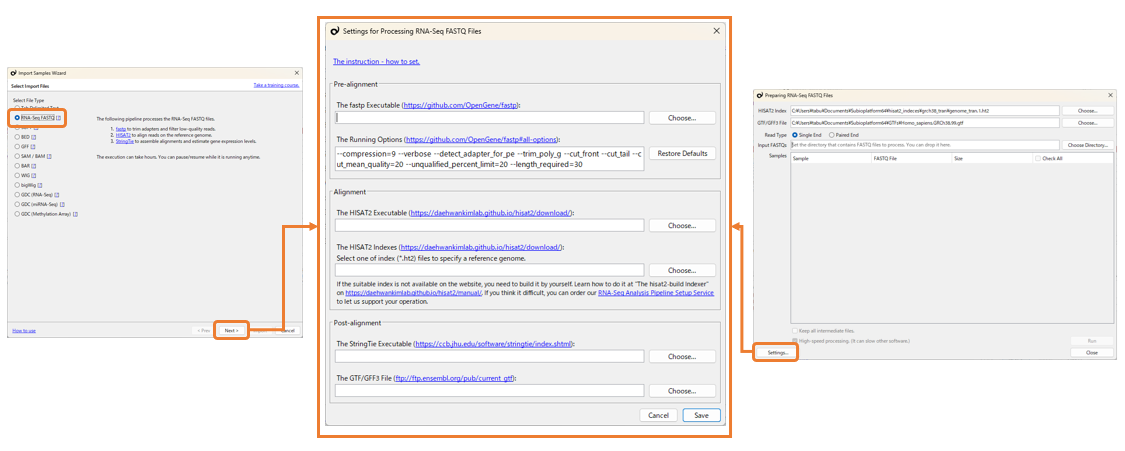
After completing the settings, we recommend first confirming that the pipeline runs correctly using a small portion of the FASTQ data.
Processing an entire FASTQ file may take a long time. If you want to perform a short test to confirm the settings, add the following fastp option:
--reads_to_process=100000
This limits the number of reads to be processed. After confirming that the pipeline runs correctly, remove this option and process all reads.
Versions Confirmed to Work
We have confirmed that the tools described above run correctly with Subio Platform using the following versions. Other versions may cause errors.
- fastp 0.22.0
- HISAT2 2.1.0
- StringTie 2.1.1
If you encounter a problem, first check whether you are using the versions listed above.
If you are still unable to resolve the problem after checking the points above, you can also use our FASTQ Processing Troubleshooting Service .