Read Depth and Dynamic Range in RNA-Seq
The range of expression levels that can be analyzed reliably by RNA-Seq depends strongly on read depth. Here, dynamic range does not simply refer to the full numerical range of the measured values. Rather, it refers to the range of signals that can be treated as reasonably reliable for analysis, excluding the low-count region where noise has a substantial influence.
When read depth is low, a large proportion of the reads comes from a relatively small number of highly expressed genes. In contrast, measuring the expression levels of lowly expressed genes reliably requires a greater number of reads.
In other words, the more lowly expressed genes you want to include in the analysis, the greater the required read depth becomes. Increasing the number of reads brings more genes into the reliable signal range, but the number of reads required increases rapidly as the dynamic range is extended toward lower expression levels.
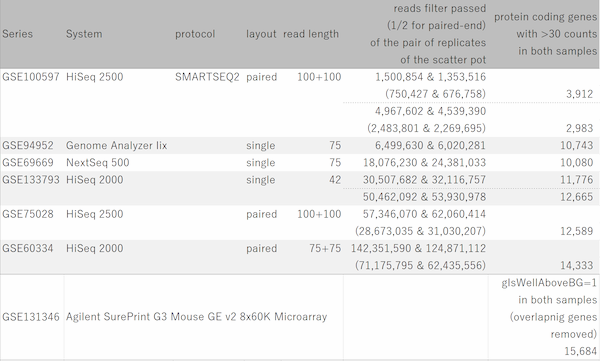
Note: The read numbers discussed in this article are expressed as the number of fragments available for analysis. In single-end RNA-Seq, one read is counted as one fragment. In paired-end RNA-Seq, one pair consisting of Read 1 and Read 2 is counted as one fragment. Therefore, when the total read count for paired-end RNA-Seq is reported by counting Read 1 and Read 2 separately, use approximately half of that number when comparing it with the values discussed in this article.
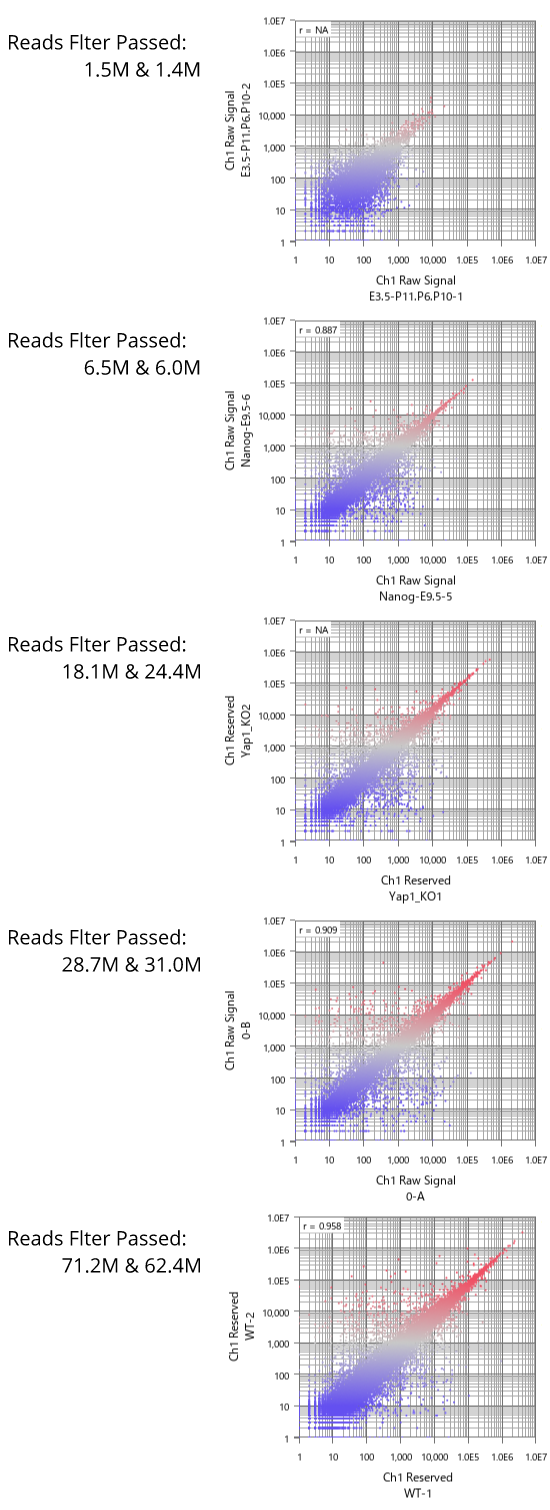
For example, in a dataset such as the one shown here, approximately 10 million reads may provide relatively stable measurements for around 10,000 of the more highly expressed genes, although this depends on the filtering criteria and the characteristics of the samples. However, the number of genes that can be measured reliably varies with factors such as tissue type, library preparation method, RNA quality, mapping rate, and the expression-level distribution. Extending the analysis further into the low-expression range requires a substantial increase in read depth.
This point can easily be overlooked when only values converted to TPM, FPKM, or RPKM are examined.
With TPM or FPKM, normalization by gene length can make the numerical range appear wider.
However, this does not mean that measurements in the low-count region have become more reliable.
For more details, see
Why TPM, FPKM, and RPKM Should Not Be Used for RNA-Seq Differential Expression Analysis.
When evaluating the dynamic range of RNA-Seq, it is important to examine the original count values and read depth, rather than relying on TPM, FPKM, or RPKM values.
Input RNA Amount Also Matters
In addition to read depth, the amount of input RNA has a major influence on the range of expression levels that can be analyzed reliably by RNA-Seq. In ultra-low-input RNA-Seq and single-cell RNA-Seq, the number of molecules obtained from each sample or cell is limited, resulting in constraints that differ from those of bulk RNA-Seq. Although technological advances continue to improve these methods, reliable quantification of lowly expressed genes requires even greater caution than in conventional bulk RNA-Seq. Particularly in the low-count region, it is necessary to distinguish carefully between a gene that is not expressed and one that simply happened not to be detected.
Differences in Read Depth Between Samples Also Matter
Even within the same RNA-Seq dataset, total read counts can differ between samples. Across many datasets, it is not unusual for the sample with the highest read count to have more than twice, and sometimes several times, as many reads as the sample with the lowest count. As the number of samples increases, so does the likelihood that the dataset will include a sample whose read depth falls substantially below the planned level.
In data analysis, filtering criteria and the range of interpretation must be determined with reference to the sample with the lowest read count. Therefore, when planning an experiment, it is safer not to rely solely on the theoretical output of the sequencer or the average obtained by dividing that output equally among the samples. For the sample with the lowest read count, it may be prudent to allow for the possibility that the actual read depth will be approximately half of the planned value.
Read-Depth Constraints Also Apply to 3′ RNA-Seq
3′ RNA-Seq is a method that mainly sequences regions near the 3′ ends of transcripts, rather than across the full transcript. It is less affected by gene length and offers advantages for efficiently processing large numbers of samples.
However, using 3′ RNA-Seq does not mean that lowly expressed genes can be measured reliably with only a small number of reads. Reliable analysis of lowly expressed genes still requires a sufficient number of molecules and reads. See: Why Use 3′ RNA-Seq? The Possibility of Measuring Lowly Expressed Genes More Deeply at the Same Cost.
Summary
In RNA-Seq, if you look only at normalized values or downstream analysis results, it is easy to overlook whether sufficient read depth was obtained in the first place. However, when read depth is insufficient, interpretation of the low-expression region becomes less reliable.
When considering the dynamic range of RNA-Seq data, it is important to first check the total number of reads and the number of usable fragments remaining after mapping, and then examine the Gene Counts distribution and reproducibility among samples to determine which range can be treated as reliable signal. For a more fundamental discussion of noise, reproducibility, and dynamic range, see What Is Good Gene Expression Data? | Understanding Noise, Reproducibility, and Dynamic Range.
With Subio Platform , you can visualize the Gene Counts distribution, variability in the low-count region, and relationships among samples to better understand and validate the characteristics of the data and consider which range should be included in the analysis.